Introduction: When Hard Materials Meet Powerful Crushing
In industries such as fertilizer production, mineral processing, and building material preparation, there is often a need to crush medium-hard to hard materials like coal lumps, limestone, shale, or dried fertilizer raw materials into uniform fine particles. Traditional hammer or jaw crushers may face issues of insufficient efficiency or rapid wear when dealing with these materials. The chain crusher, with its unique chain-hammer composite design, has become the ideal choice for handling such materials. It holds an important position in the field of industrial crushing due to its powerful impact force and excellent wear resistance.
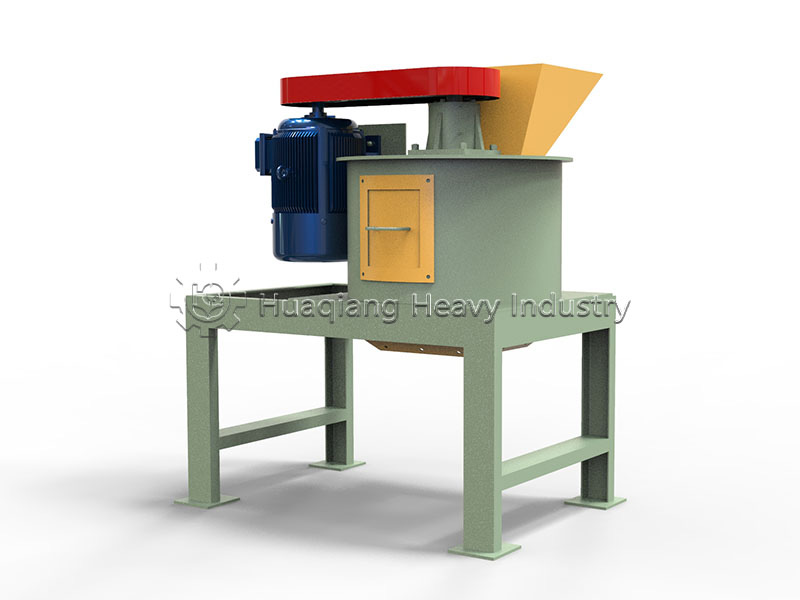
I. Core Design: The Crushing Revolution Brought by Chains
The core innovation of the chain crusher lies in its rotor assembly. Instead of using fixed hammers, multiple high-strength alloy steel chains are suspended from the rotor, with wear-resistant hammer heads (chain heads) attached to their ends. When the rotor rotates at high speed driven by a motor (chain head peripheral speed can reach 28-78 m/s), these freely swinging chains and hammer heads act like countless high-speed whipping steel lashes, delivering omnidirectional and violent impacts to the material entering the crushing chamber.
This design offers multiple advantages: First, the freely swinging chains can better “wrap around” and strike irregularly shaped materials. Second, when encountering unbreakable foreign objects, the chains can yield to a certain extent, reducing impact on the main shaft and protecting the equipment. Finally, the combined effect of chain impact, collision between material and the chamber’s liner plates, and inter-particle friction creates an efficient composite crushing mechanism.
II. Working Principle: A Trilogy for Fine Crushing
The workflow of a chain crusher is clear and efficient:
- Feeding and Primary Crushing:Material enters the sturdy housing through the feed inlet and immediately encounters the first wave of impact from the high-speed rotating chain hammers. Large lumps of material are rapidly fractured.
- Multiple Crushing and Grinding:The material being crushed is repeatedly tossed within the chamber, subjected to continuous impacts from chains at different angles. Simultaneously, smaller particles move at high speed inside the chamber, colliding violently and grinding against the liner plates and other particles, being further refined. This process combines impact crushing with some grinding action.
- Sieving and Qualified Discharge:Material refined to a certain degree is pushed towards the bottom screen by airflow and centrifugal force. Only particles smaller than the screen apertures pass through and are discharged from the outlet. Oversized particles are retained by the screen and continue to be crushed inside the chamber until they meet the size requirement.
III. Structural Types: Adapting to Different Scale Needs
To meet diverse production needs, chain crushers mainly come in two structures:
Single-Motor Vertical Structure: Compact design with a small footprint, featuring a vertically arranged rotor. Suitable for small to medium-scale production lines with limited space or applications with lower throughput requirements. A common choice for fertilizer plants and small building material factories.
Dual-Motor Horizontal Structure: Features two horizontally arranged rotors, each independently driven by a motor, providing powerful crushing capacity. This design is typically used for large-scale industrial production, such as in large cement plants, mining operations, or large compound fertilizer production lines, capable of achieving throughputs of tens or even hundreds of tons per hour.
IV. Outstanding Advantages: Why is it Highly Favored?
Chain crushers demonstrate significant advantages across multiple dimensions:
- High-Efficiency Crushing Capacity:High-speed impacts can quickly disintegrate hard materials, resulting in high production efficiency.
- Wide Material Adaptability:It can not only process hard materials such as coal and limestone, but also has a good crushing effect on fertilizer raw materials and clay containing a certain amount of moisture or viscosity.
- Excellent Product Size Control:By changing the sieves with different mesh sizes, the particle size of the final product can be easily adjusted to meet the precise requirements of downstream processes.
- Robust Durability and Easy Maintenance:Key components like chains, chain heads, and liner plates are made of wear-resistant materials for long service life. The equipment is designed with large access doors, making the replacement of wear parts and routine maintenance very convenient.
- Good Overload Protection:The flexible connection characteristics of the chain provide a certain degree of cushioning when encountering unbreakable foreign objects such as metal fragments, thereby reducing the risk of sudden equipment failure.
V. Typical Applications: Empowering Multiple Industries
The chain crusher is a versatile key piece of equipment in multiple industries:
Fertilizer Industry: Used for crushing raw materials like phosphate rock and potash feldspar, or for crushing and screening dried compound fertilizer lumps.
Building Materials Industry: Crushing raw materials like limestone, shale, and gypsum for cement or brick production.
Mining and Energy: Used for primary crushing of coal or other medium-hardness ores.
Chemical Industry: Processing certain caked chemical raw materials or intermediate products.
From Crushing to Granulation: An Integrated Production Workflow
Efficient material reduction, such as that achieved by a chain crusher, is a critical pre-processing step in modern fertilizer manufacturing, serving both npk fertilizer production line and organic fertilizer production line systems. The uniformly crushed powder is then precisely formulated, often using a npk blending machine for compound fertilizers, before entering the core fertilizer granulation processes. Advanced fertilizer granulation technology offers diverse pathways: dry granulation processes utilize equipment like the double roller press granulator in a roller press granulator production line, while wet methods might employ a disc granulator for shaping in a disc granulation production line.
For organic production, the chain often starts with a windrow composting machine for biodegradation before granulation. The choice of fertilizer processing machine—be it a disc granulator machine, roller press, or other fertilizer granulator—is determined by the material properties and final product specifications. Whether configured for a high-volume npk fertilizer line or a specialized bio organic fertilizer production line, this integration of pre-processing, precise blending, and selective granulation ensures the efficient production of high-quality, consistent fertilizers that meet the specific demands of global agriculture.
Conclusion
Chain crushers, with their unique crushing principle, strong adaptability, and exceptional durability, have successfully solved the problem of efficiently crushing medium-hard materials in the industrial field. They transform the initial impact force into controllable, refined crushing force, becoming an indispensable bridge connecting raw material pretreatment and subsequent deep processing stages. With the continuous advancement of materials science and manufacturing technology, future chain crushers will develop towards higher energy efficiency, intelligence, and lower wear, continuing to provide reliable core equipment support for global industrial production and resource processing.