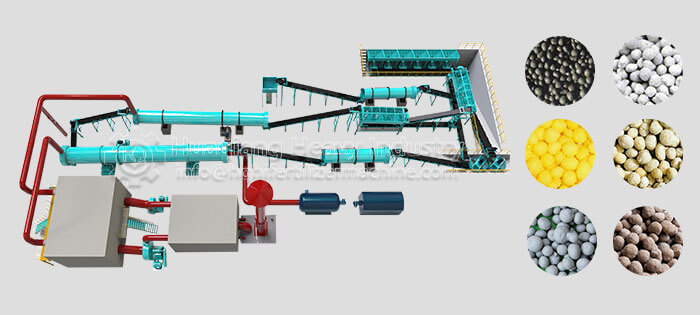
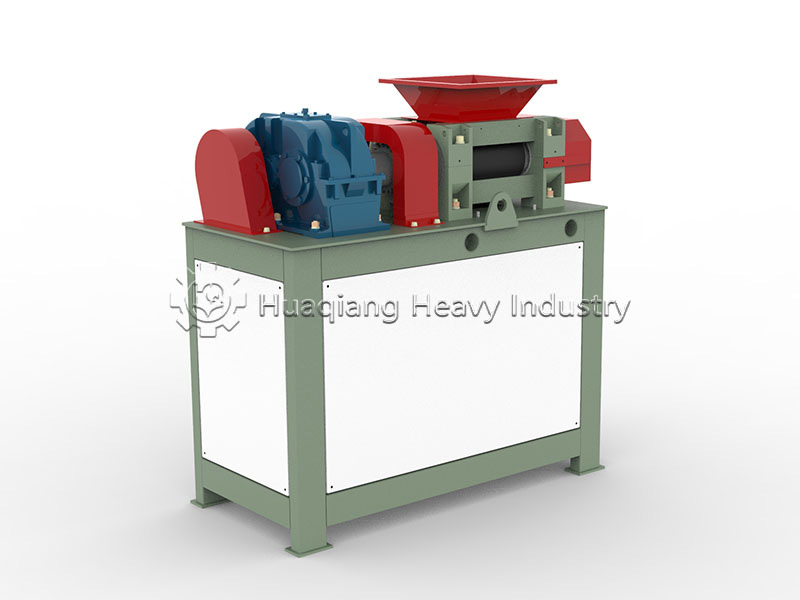
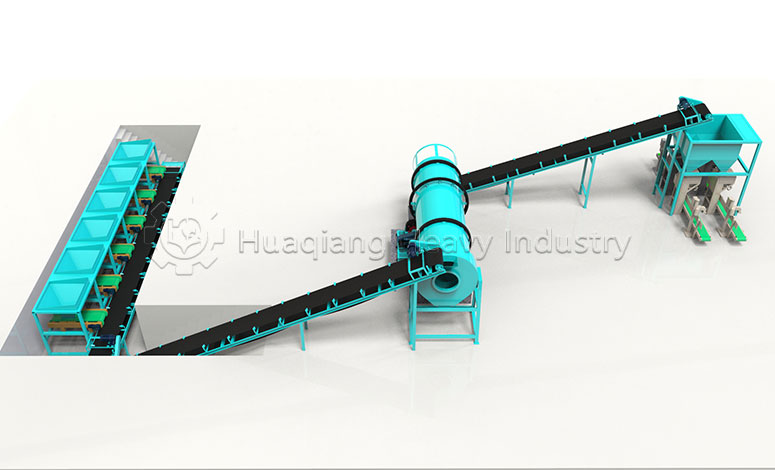
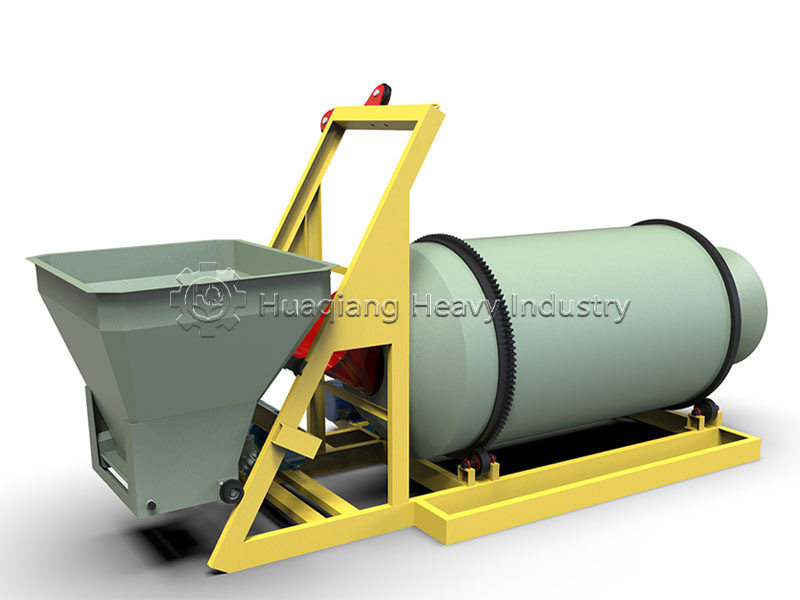
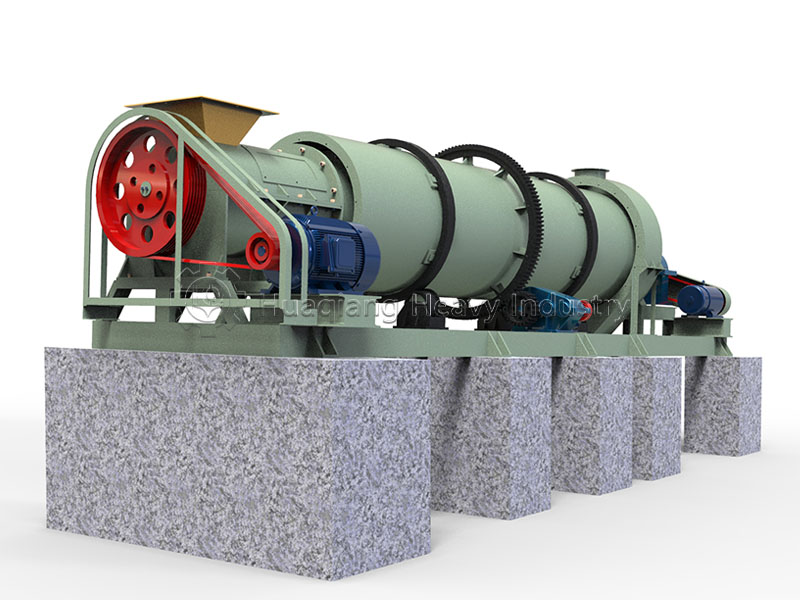
In modern fertilizer production, granulators perform a crucial transformation—transforming uniformly mixed powdery raw materials into neat, solid granules.
For production companies, the most direct change brought about by granulation is the optimization of physical properties. Granular fertilizers have better flowability, greatly improving the efficiency of packaging, transportation, and mechanized application. Whether on NPK fertilizer production lines or organic fertilizer production lines, this improvement in physical properties directly translates into economic benefits.
From an equipment application perspective, while specialized organic fertilizer granulators and chemical fertilizer granulation equipment have different technological focuses, their core objective is the same: to lay the foundation for subsequent processes by shaping ideal granules. In a complete organic fertilizer production line, the granulation process is often the core link between fermentation and composting and finished product packaging.
From an agronomical perspective, the uniform granule shape creates conditions for precision fertilization. On NPK fertilizer production lines, each finished product carries a precisely proportioned nutrient solution; while on organic fertilizer production lines, granules become the ideal carrier of organic matter and functional microbial communities. This consistency in form allows for more controllable nutrient release and more coordinated crop absorption.
This equipment, connecting raw materials and finished products, has become a core component of both NPK fertilizer production lines and organic fertilizer production lines. By reshaping fertilizer form, it not only enhances product competitiveness but also establishes an indispensable industry position in the trend of agricultural mechanization and precision.
As an efficient vertical conveying equipment, bucket elevators play a vital role in modern industrial production. Through buckets installed on traction components, they lift materials from low to high positions, achieving large-scale vertical transportation of bulk materials in limited spaces. This equipment not only saves valuable factory space but also significantly improves material handling efficiency.
Industry Application Scenarios
In the mining and metallurgy industry, bucket elevators are core components of material handling systems. They reliably lift heavy materials such as ores, slag, and coke, enduring harsh working environments and heavy workloads. These equipment typically feature heavy-duty designs and wear-resistant materials to ensure stable operation under demanding conditions.
The building materials industry shows particular dependence on bucket elevators. Cement plants, lime factories, and various building material processing plants use bucket elevators to transport raw materials from storage silos to production equipment. These devices must handle various materials from coarse particles to fine powders while maintaining good sealing to prevent dust pollution.
The chemical industry has special requirements for conveying equipment. Beyond basic transportation functions, bucket elevators need features like corrosion resistance and explosion protection. Stainless steel bucket elevators are widely used in this field, safely transporting potentially corrosive materials such as fertilizers and chemical raw materials.
The grain and food industry imposes strict hygiene standards. Bucket elevators used in this sector must be manufactured with food-grade materials and designed for easy cleaning to ensure no contamination of transported products like grains, flour, and sugar. Special surface treatments and sealing designs are key features of such equipment.
Material Characteristics and Equipment Selection
For materials with different characteristics, the design and configuration of bucket elevators require corresponding adjustments. Block materials like ores and coal need deep or shallow buckets, which effectively prevent material fall during lifting. Meanwhile, equipment operating speed needs appropriate control to ensure materials remain stable in the buckets.
Transporting granular materials requires consideration of different factors. Medium-sized materials like fertilizer granules and plastic pellets suit medium-depth buckets, achieving good balance between conveying efficiency and material stability. Equipment operating parameters need precise adjustment based on material particle size, humidity, and flowability.
Powdered materials pose the highest requirements for bucket elevators. Fine powders like cement and flour easily generate dust, necessitating excellent sealing performance. Belt-type bucket elevators with efficient dust control devices can effectively control dust diffusion, protect the working environment, and reduce material loss.
With continuous development of industrial technology, bucket elevator applications across various industries are continuously expanding and deepening. Modern bucket elevators not only focus on lifting efficiency and reliability but have also made significant progress in intelligent control, energy conservation, and environmental protection. Selecting appropriate bucket elevators and correctly configuring their working parameters is crucial for optimizing production processes and improving production efficiency.
Vertical Conveying in Modern Fertilizer Manufacturing Systems
Within the comprehensive npk fertilizer production line, bucket elevators serve as crucial material handling components, seamlessly connecting various stages of the manufacturing of npk fertilizer. These systems efficiently transport raw materials to precision equipment like the npk bulk blending machine for accurate formulation, and subsequently to advanced npk granulation machine technology systems. The npk fertilizer granulator machine relies on consistent material supply from these conveying systems to maintain continuous production flow and product uniformity.
The integration of efficient vertical conveying with sophisticated processing equipment represents a key aspect of modern npk fertilizer production technology. This coordinated material handling ensures that powdered and granular materials move seamlessly between blending, granulation, drying, and packaging stages, minimizing production bottlenecks and maintaining quality consistency. The synergy between conveying systems and processing machinery in the complete npk fertilizer production line enables large-scale, efficient fertilizer manufacturing while supporting the precise material control required for producing consistent, high-quality NPK fertilizers that meet specific agricultural nutrient requirements and application standards across diverse farming systems.
In the wave of green development in modern agriculture, the bio-organic fertilizer production line, with its unique resource conversion capabilities, transforms various organic wastes into high-value-added bio-fertilizers. This complete production system, through the coordinated operation of specialized equipment, achieves an intelligent transformation from raw materials to finished products.
The core value of the entire bio-organic fertilizer production line lies in its systematic process flow. From the initial raw material fermentation treatment, to the intermediate addition and mixing of microbial agents, and then to the final molding processing, each step relies on the precise coordination of specialized bio-organic fertilizer equipment.
At the rear end of the production line, fertilizer granules compaction technology demonstrates its unique value. This technology not only significantly improves the physical properties of the product, making it easier to store and transport, but also greatly enhances its marketability, creating favorable conditions for mechanized fertilization.
Of particular note is that modern bio-organic fertilizer production lines consistently prioritize maintaining the activity of functional microorganisms during processing. From the ratio of microbial agents to the control of molding temperature, each step is meticulously designed to ensure that beneficial microorganisms remain active during processing, ultimately fulfilling their due biological functions in the product.
In the modern fertilizer manufacturing field, NPK blending fertilizer production lines, with their precise formulation execution capabilities and flexible production modes, provide strong guarantees for the precise supply of nutrients to crops. This system achieves precise proportions and uniform distribution of various nutrients through the perfect coordination of specialized equipment.
As the core of the entire production line, the NPK blending machine undertakes the crucial mixing task. Its unique structural design ensures that nitrogen, phosphorus, potassium, and various micronutrients reach an ideal mixing state in a short time. This efficient blending process not only guarantees the uniform distribution of nutrients but also ensures that each bag of finished fertilizer has a completely consistent nutrient content.
The fertilizer mixer machine, working closely with the NPK blending machine, plays an important auxiliary role in the mixing process. Through secondary homogenization of the materials, it further improves the homogeneity of the product and eliminates any potential mixing dead zones. The seamless cooperation between the two machines forms the foundation for the quality assurance of the NPK blending fertilizer production line.
The advantage of the entire NPK blending fertilizer production line lies in its outstanding flexibility. Compared to traditional compound fertilizer production lines, it can quickly adjust the formula composition according to different soil characteristics and crop needs, achieving customized production of small batches and multiple varieties. This characteristic allows fertilizer products to better adapt to regional and individualized agronomic requirements.
NPK fertilizer production lines are crucial for compound fertilizer production. As a key piece of equipment, BB fertilizer mixers, when integrated with the production line, significantly improve overall production efficiency and product quality. NPK fertilizer production involves processes such as raw material crushing, mixing, granulation, and drying. The mixing stage directly impacts the nutrient balance of the final product, and BB fertilizer mixers are a perfect fit for this requirement.
In the production line, raw materials processed by the fertilizer crusher are delivered to the BB fertilizer mixer via a fertilizer conveyor. Upon startup, the drive system drives the mixing shaft and blades, evenly mixing nitrogen, phosphorus, and potassium, laying a solid foundation for the subsequent granulation process. Inhomogeneous mixing can result in significantly different nutrient distributions in the granulated fertilizer, impacting product quality.
The BB fertilizer mixer’s control system can be linked with the overall production line control system to synchronize parameters such as mixing speed and time, ensuring a smooth production process. After mixing, the uniform raw materials are discharged through the discharge port and sent to the granulator by conveyor. It works efficiently with subsequent equipment such as dryers and coolers to form a complete NPK fertilizer production chain, helping companies achieve large-scale, high-quality production.
While the new type two in one organic fertilizer granulator simplifies the organic fertilizer production process with its integrated design, it has more specific requirements regarding the adaptability of the processed materials.
Precise control of material particle size is crucial. Raw materials entering the new type two in one organic fertilizer granulator must undergo crushing and screening to ensure uniform particle size controlled within the 1-3 mm range. Large impurities or incompletely crushed lumps in the material will not only clog the equipment’s feed channel and die holes but may also accelerate the wear of internal components, affecting granulation continuity. Excessively fine powdery materials are prone to generating dust and will result in insufficient granule strength after molding.
Material moisture control is critical. The suitable material moisture content is 20%-30%, which needs to be fine-tuned based on the raw material composition. Excessive moisture content causes the material to easily clump together inside the machine, leading to a decrease in granulation rate and potentially causing die blockage. Insufficient moisture content results in a lack of viscosity, making it difficult to form through extrusion or granulation processes, and even if formed, it is prone to breakage.
The material composition ratio must be scientific. The carbon-to-nitrogen ratio of the raw materials should be maintained at 25-30:1. Avoid imbalances in the proportion of single high-nitrogen raw materials (such as poultry and livestock manure) or high-carbon raw materials (such as straw), otherwise the stability of the fertilizer effect after pelleting will be affected. At the same time, the proportion of fiber components in the material should not be too high. Excessive fiber can easily entangle equipment parts, requiring pretreatment to decompose some coarse fibers. If the raw material lacks viscosity, a suitable amount of natural binder can be added to improve the pelleting effect.
Furthermore, the material must be fully decomposed. Undecomposed raw materials may undergo secondary fermentation after granulation in the new type two in one organic fertilizer granulator, causing the pellets to expand and break, and potentially leading to seedling burn during fertilization.
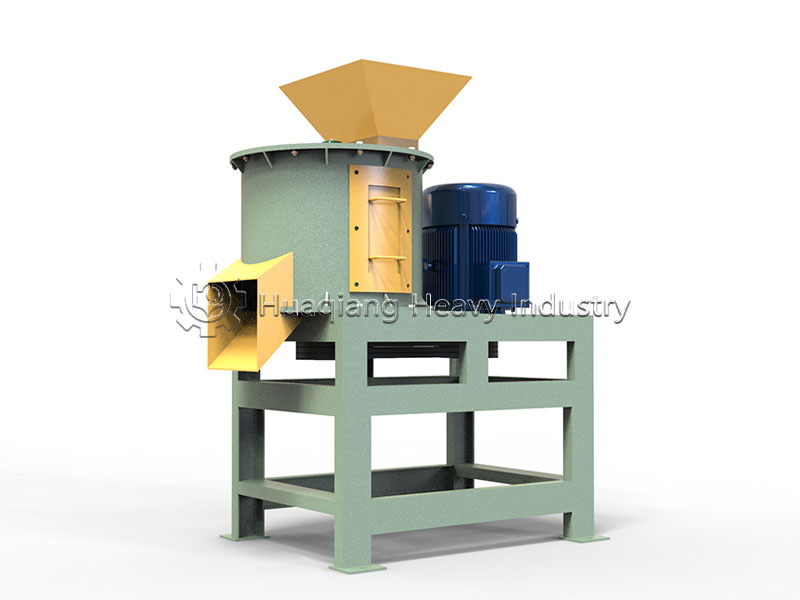
In modern organic fertilizer production lines, the half-wet material crusher, as a crucial piece of equipment, demonstrates unique raw material processing capabilities. Unlike traditional fertilizer crushers, it is specifically designed for high-moisture organic materials, effectively solving the crushing problem of raw materials after fermentation.
In the complete organic fertilizer production line process, the half-wet material crusher occupies a critical position after the fermentation process and before the granulation process. It can directly process organic materials with a moisture content of 25%-50%, including livestock and poultry manure, filter mud, and straw. This characteristic not only simplifies the process flow but also significantly reduces the energy consumption cost of the entire organic fertilizer production line.
In practical applications, the half-wet material crusher forms a good synergistic effect with other organic fertilizer production equipment. The materials processed by it meet the requirements of subsequent processes in terms of particle size uniformity and moisture content, creating favorable conditions for the stable operation of the organic fertilizer granulator. Uniform raw material particle size not only improves granulation quality but also ensures the consistency of nutrients in the final product.
It is worth mentioning that this crushing equipment exhibits broad raw material adaptability in organic fertilizer production lines. Whether it’s highly viscous livestock and poultry manure or straw-like materials with high fiber content, ideal pulverization results can be achieved by adjusting the equipment parameters. This flexibility makes it an indispensable key piece of equipment in modern organic fertilizer production lines.
Modern fertilizer production is a highly systematic process involving a complete industrial chain from raw material processing to finished product packaging. Fertilizer production equipment can be divided into five key systems according to the technological process, each playing an indispensable role.
Raw Material Pretreatment System
Raw material pretreatment is the first process in fertilizer production. Crushers are responsible for breaking down bulk raw materials such as potash ore and straw to suitable particle sizes below 8 millimeters. Mixers uniformly blend raw materials including nitrogen, phosphorus, and potassium according to precise formulas, ensuring balanced nutrient distribution. Screening machines remove impurities through vibration screening and precision filtration, providing clean raw materials for subsequent processes.
Core Reaction and Fermentation System
Depending on the fertilizer type, core reaction equipment has distinct characteristics. Organic fertilizer production mainly relies on fermentation turners and maturation tanks, converting organic materials into stable humus through aerobic fermentation processes. Chemical fertilizer production uses equipment such as dissolution tanks, flotation machines, and crystallizers to achieve raw material purification and transformation. Chelation tanks effectively prevent precipitation of medium and trace elements, ensuring fertilizer quality.
Granulation and Forming System
Granulation is a core step in fertilizer production. Extrusion granulators form granules through high-pressure extrusion and are suitable for materials such as organic fertilizers and potassium chloride. Disc granulators utilize centrifugal force to precisely control particle size within the 2-4 mm range. Spray granulators produce water-soluble fertilizers through atomization and drying processes, while coating granulators can precisely control the coating of slow-release fertilizers. Drum granulators, with their large-scale production capacity, are the preferred equipment for NPK compound fertilizer production.
Post-treatment and Packaging System
After granulation, the fertilizer requires meticulous post-processing. A secondary screening machine ensures uniform particle size, while anti-caking equipment uses a special coating agent to prevent clumping during storage. Environmental protection equipment, including dust removal and wastewater treatment systems, ensures the production process meets environmental requirements. The final packaging process utilizes automated equipment for accurate metering and efficient packaging.
Modern fertilizer production lines achieve efficient and environmentally friendly large-scale production through the coordinated operation of various systems. Taking a typical NPK compound fertilizer production line as an example, the entire process from raw material pretreatment to finished product packaging can reach a daily output of 500 tons. The products fully comply with national quality standards, providing a reliable fertilizer guarantee for global agricultural production.
Integrated Fertilizer Manufacturing: Advanced Technologies and Equipment
The comprehensive npk fertilizer production line exemplifies modern fertilizer granulation technology, integrating specialized equipment for optimal efficiency. The process begins with precise formulation using npk blending machine technology, followed by advanced fertilizer granulation processes that include both wet and dry granulation processes. Equipment selection varies by product type, with the disc granulator machine serving as the core of disc granulation production line systems, while the double roller press granulator forms the basis of roller press granulator production line operations for specific material requirements.
Parallel to chemical fertilizer production, the organic fertilizer production line and bio organic fertilizer production line utilize specialized equipment like the windrow composting machine for efficient organic matter decomposition. These diverse fertilizer granulator technologies, from disc granulator systems to specialized pressing equipment, represent the pinnacle of professional fertilizer manufacturing equipment. The continuous innovation in fertilizer granulation technology ensures that modern production lines can meet the growing global demand for both conventional and specialized fertilizers while maintaining high quality standards and environmental compliance across all fertilizer granulation processes.
In the wave of sustainable agricultural development, organic fertilizers are playing an increasingly important role as a crucial link connecting waste resource utilization and soil health. Understanding the classification system of organic fertilizers is essential for scientific selection and application.
Raw Materials: Diverse Resource Foundation
The raw material sources for organic fertilizers are extremely diverse, primarily categorized into four major types. Livestock manure organic fertilizers are the most common type, including chicken manure, cattle manure, and pig manure. These materials have balanced nitrogen, phosphorus, and potassium content, with organic matter accounting for 25%-40%, making them ideal for improving various soil types. Straw-based organic fertilizers use crop residues as raw materials, rich in cellulose and lignin, with organic matter content as high as 50%-70%, significantly improving soil permeability and water retention capacity. Food waste organic fertilizers achieve resource recycling through the recovery of kitchen waste, but require strict quality control. Industrial byproduct organic fertilizers include distillers’ grains, vinegar residues, and other industrial wastes, offering unique nutritional components and improvement effects.
Modern organic fertilizer production plants typically select the most economical and sustainable raw material combinations based on local resource advantages, maximizing the value of waste resource utilization.
Production Processes: Technology Determines Quality
From the perspective of production processes, organic fertilizers can be divided into three major types. Fermented and matured organic fertilizers are the mainstream products in the market, using aerobic or anaerobic fermentation processes to completely eliminate pathogens and insect eggs, ensuring product safety and reliability. Bio-organic fertilizers add functional microorganisms, such as Bacillus subtilis and phosphorus-potassium solubilizing bacteria, on the basis of fermentation, combining the dual benefits of organic and microbial fertilizers. Organic-inorganic compound fertilizers scientifically blend organic fertilizers with chemical fertilizers, maintaining the soil improvement advantages of organic fertilizers while possessing the quick-acting characteristics of chemical fertilizers.
Usage Classification: Key to Precision Fertilization
Based on different applications, organic fertilizers can be divided into two major categories: general-purpose and specialized. General-purpose organic fertilizers have balanced nutrients and are suitable for most crops, serving as the basic fertilizer for organic agriculture. Specialized organic fertilizers are formulated according to the nutritional needs of specific crops – for example, vegetable-specific fertilizers focus on nitrogen supply, fruit tree-specific fertilizers emphasize potassium elements, while flower-specific fertilizers highlight organic matter content. This precise product classification enables growers to select the most suitable fertilizer products based on specific crops and growth stages.
With the continuous development of the organic fertilizer industry, the product classification system is also constantly improving. From raw material selection to production processes, from basic functions to specialized applications, the diversification of organic fertilizers provides strong support for sustainable agriculture. In the future, with technological advancements and changing market demands, the classification system of organic fertilizers will continue to optimize, contributing more power to the green development of global agriculture.
Modern Organic Fertilizer Manufacturing: From Classification to Production
The diverse classification of organic fertilizers is supported by sophisticated manufacturing systems that transform raw materials into specialized products. Modern organic fertilizer manufacturing utilizes complete organic fertilizer production line systems that integrate various specialized equipment. The process begins with efficient organic fertilizer fermentation equipment, including the large wheel compost turning machine for large-scale operations, which ensures proper aeration and temperature control during the critical decomposition phase.
Following fermentation, the material proceeds to the organic fertilizer granulator for shaping into uniform, market-ready pellets. For specialized products, the bio organic fertilizer production line incorporates additional microbial inoculation stages to create fertilizers enriched with beneficial microorganisms. This integrated approach to organic fertilizer manufacturing enables the production of diverse fertilizer types – from general-purpose to crop-specific formulations – while maintaining quality consistency and maximizing the nutritional value derived from various organic waste sources. The continuous advancement of these production technologies supports the growing demand for sustainable fertilization solutions in modern agriculture.