In the final stage of the organic fertilizer production process, the efficiency and quality of the packaging process directly affect the product’s market performance. While traditional manual packaging methods require less investment, they are no longer adequate for modern production demands. With technological advancements and increased scale in the industry, packaging equipment is evolving from manual to semi-automatic and then to fully automatic processes. This transformation not only improves production efficiency but also achieves a qualitative leap in precision and standardization.
Limitations and Applicable Scenarios of Manual Packaging
For small production lines or startups with a daily capacity of less than 50 tons, manual packaging remains a common choice. This method requires no expensive equipment investment, is simple and flexible to operate, and can adapt to the needs of multi-specification, small-batch production. However, the limitations of manual packaging are also quite obvious: each person can only complete 2-3 tons of packaging per day, packaging accuracy is difficult to control, and the error is usually within ±5%. The high labor intensity of long-term packaging work and the poor consistency of product appearance all restrict the scaled development of enterprises.
More importantly, dust pollution during manual packaging is difficult to control effectively, affecting not only the health of operators but also potentially leading to product quality issues. With rising labor costs and intensifying market competition, the economic viability of traditional manual packaging is gradually diminishing.
The Widespread Application of Semi-Automatic Packaging Machines
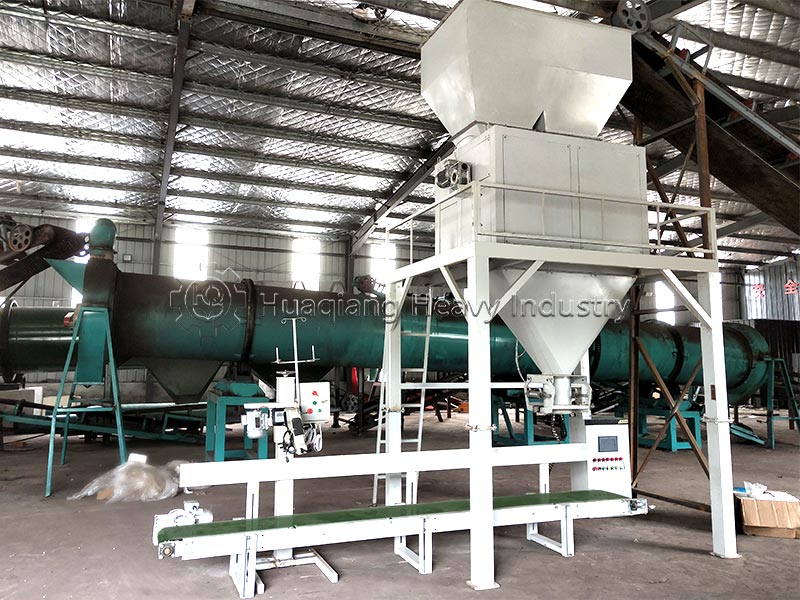
When the daily production capacity reaches 50-200 tons, semi-automatic packaging machines become the most cost-effective option. This equipment employs a semi-automatic design with manual bagging assistance and automatic weighing and sealing, significantly improving packaging efficiency while maintaining flexibility. Operators are primarily responsible for bagging and monitoring equipment operation; packaging weighing is precisely controlled by electronic sensors, with an error consistently within ±1%.
The price of a single semi-automatic packaging machine is typically between 30,000 and 50,000 yuan, with a short investment payback period, generally not exceeding 6 months. The equipment structure is relatively simple, maintenance is convenient, and the technical requirements for operators are not high, making it suitable for most small and medium-sized organic fertilizer production enterprises. The semi-automatic packaging machine series launched by Huaqiang Heavy Industry is also equipped with a dust collection device, effectively improving the working environment and meeting the environmental protection requirements of modern production.
The Scalability Advantages of Fully Automated Packaging Systems
For large-scale organic fertilizer production lines with a daily capacity exceeding 200 tons, fully automated packaging systems offer unparalleled advantages. This system automates the entire process from bagging, weighing, sealing to palletizing, achieving a production efficiency of 20-50 tons per day. Utilizing a PLC intelligent control system, the packaging weight can be precisely adjusted within the range of 20-50 kg according to requirements, with an error controlled within ±0.5%.
Huaqiang Heavy Industry’s fully automated packaging system is designed with the specific characteristics of organic fertilizer production in mind. The equipment uses corrosion-resistant materials to adapt to the chemical properties of organic fertilizer; it is equipped with a multi-layer filtration and dust removal system to ensure a clean packaging environment; and its modular design facilitates maintenance and upgrades. More importantly, the system can be linked with other equipment on the production line to form a complete automated production chain.
Practical Application Results and Return on Investment
A transformation case study of a large organic fertilizer production company fully demonstrates the value of automated packaging. This company previously used manual packaging methods, requiring six operators, with a daily packaging capacity of only 30 tons and a packaging error rate of 3%. After introducing the Huaqiang Heavy Industry fully automated packaging system, only one monitoring personnel are needed in the packaging process, increasing daily packaging capacity to 80 tons and reducing the error rate to 0.3%.
The economic benefits of the upgrade are significant: annual labor cost savings exceed 200,000 yuan, and packaging efficiency increases by over 160%. More importantly, the improved packaging quality directly enhances product market competitiveness; standardized packaging specifications and precise weight control have earned customer trust, resulting in a comprehensive improvement in brand image. The equipment investment can be fully recovered within one year through cost savings.
Packaging: The Final Step in the Fertilizer Production Chain
The automated packaging process is the critical interface between manufacturing and the market, but it is entirely dependent on the quality of the granules produced upstream. These granules are created in the core npk fertilizer production process or organic lines. In an npk fertilizer production line, raw materials are first blended in a npk bulk blending machine before granulation. Granulation may involve a disc granulation production line using a disc granulator (with a disc granulator for shaping), or a roller press granulator production line using a double roller press granulator for dry compaction.
Similarly, in an organic fertilizer line fed by a windrow composting machine, the cured compost is shaped via granulation before packaging. The physical properties of these granules—their size uniformity, hardness, and dust content—directly impact the performance of the fertilizer packing machine. A consistent, hard granule flows smoothly, allowing for faster and more accurate weighing and bagging. Therefore, the efficiency of the entire npk fertilizer line is only fully realized when high-quality granulation is seamlessly coupled with reliable, automated packaging.
Investing in advanced packaging technology is thus the final step in capturing the full value created by the upstream production equipment. It transforms bulk material into a branded, ready-to-sell product, ensuring that the investment in granulation and blending machinery delivers maximum return.
Selection Strategy and Future Outlook
When selecting packaging equipment, companies should comprehensively consider their own production capacity, investment budget, and development plans. Small businesses can start with semi-automatic equipment and gradually upgrade as they expand; large enterprises should directly choose fully automated systems to achieve optimal production efficiency and product quality control.
Looking to the future, with the development of IoT and AI technologies, packaging equipment will further evolve towards intelligence. Intelligent identification systems will be able to automatically detect packaging quality, big data analysis can optimize packaging parameters, and remote monitoring systems can achieve intelligent equipment management. These technological advancements will make the organic fertilizer packaging process more efficient, precise, and environmentally friendly. In today’s increasingly competitive organic fertilizer industry, the modernization of packaging is not only crucial for production efficiency but also for a company’s market competitiveness and brand value. Choosing suitable packaging equipment and implementing scientific packaging management will be essential for organic fertilizer companies to enhance their overall competitiveness. Huaqiang Heavy Industry, as a leading equipment supplier in the industry, will continue to dedicate itself to packaging technology innovation and provide customers with more comprehensive product solutions.