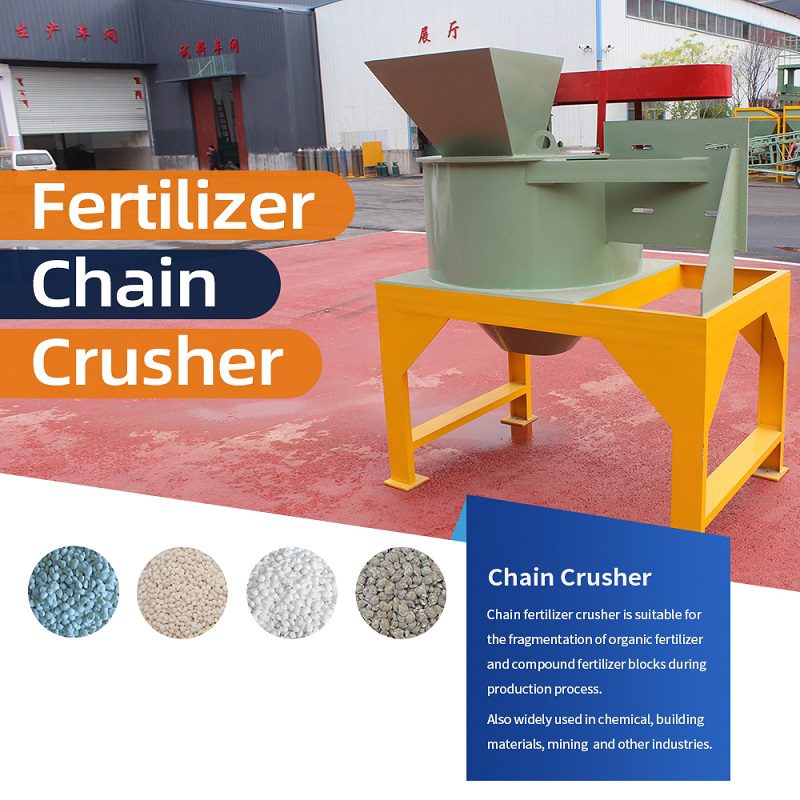
In fertilizer production lines, chain crushers play a crucial role as the “pioneers” of raw material pretreatment. Their operational stability directly affects the accuracy of subsequent batching and granulation quality. However, high-intensity, continuous crushing operations make problems such as material jamming and uneven particle size frequent issues that plague many production workshops. Mastering the rapid diagnosis and solutions for these common faults, and implementing thorough daily maintenance, are key to ensuring the continuous and efficient operation of the production line. This article will focus on chain crushers, providing you with a practical guide from rapid troubleshooting to preventive maintenance.
High-Frequency Fault 1: Material Jamming or Blockage at the Inlet
This is one of the most troublesome sudden faults in production, usually accompanied by abnormal equipment noise or complete shutdown.
Step-by-step troubleshooting and quick solutions:
Immediately stop the machine and cut off the power: This is the primary principle of safe operation. Subsequent inspections can only be performed after ensuring the equipment is completely stopped and the power is cut off.
Reverse troubleshooting method: First, check if the outlet is blocked. Sometimes, downstream conveying equipment failure or screen blockage can cause material to accumulate in the crushing chamber, leading to a blockage at the inlet. Clearing the outlet is the first step.
Check the incoming material: If the outlet is clear, the problem is most likely in the incoming material itself. Focus on checking for the presence of excessively hard foreign objects (such as iron blocks, stones) or long, easily tangled fibrous materials that exceed the equipment’s design specifications. In the production of organic and inorganic compound fertilizers, the inclusion of insufficiently crushed packaging ropes and plastic films in the raw materials is a common cause.
Targeted cleaning and adjustments:
For hard object jamming: Open the inspection door and carefully remove the foreign object using professional tools (never use your hands directly).
For entanglement and fluffy material blockage: In addition to cleaning, prevention from the source is necessary. Adjust the speed of the front-end feeder to ensure uniform and continuous feeding, avoiding excessive instantaneous flow. For easily tangled materials, consider installing a simple hook-type cleaning grate above the inlet. II. High-Frequency Fault 2: Uneven Particle Size After Crushing, Excessive Fine Powder or Oversized Particles
The finished product particle size does not meet process requirements, which will seriously affect the pelletizing rate and particle strength in subsequent granulation.

Step-by-step troubleshooting and solutions:
First, check the screen (sieve plate): This is the component with the highest failure rate. After shutting down, immediately check if the screen is damaged, worn, or clogged.
Damage: This will cause some unqualified coarse particles to leak out directly, and the screen must be replaced immediately.
Severe wear: The sieve holes are worn larger, also leading to coarser particle size. The sieve hole size should be measured regularly.
Clogging: Materials with high humidity or sticky raw materials (such as some recycled materials) can easily clog the sieve holes, preventing qualified fine powder from being discharged in time, resulting in excessive crushing inside the machine and the production of too much powder. The solution is to clean the screen and optimize the moisture content of the material in the preceding process.
Check the wear status of the hammer heads: The hammer heads are the components that directly perform the work. When the hammer heads are severely worn, their crushing efficiency decreases, and the impact and shearing force on the material are insufficient, leading to an increase in coarse particles. Regular inspections should be performed. When the wear on one side of the hammer head reaches one-third of its original size, it is recommended to change the direction or replace them in sets to maintain rotor balance.
Check the rotor speed and clearance: Under the premise of ensuring safety, a professional electrician should inspect the motor and transmission system to ensure that the rotor reaches the rated speed. Insufficient power will lead to weak crushing. At the same time, check the working clearance between the hammer head and the screen. Too large a gap will reduce the crushing effect, while too small a gap will accelerate wear and may produce excessive fine powder. This gap should be adjusted to the optimal range recommended in the equipment manual (usually 10-20 mm) according to the material characteristics (such as hardness and brittleness) and product particle size requirements.

III. Prevention is Better Than Cure: Daily and Periodic Maintenance Key Points
Prevention is far better than repair. Establishing a standardized maintenance system can greatly reduce the failure rate.
Daily/Shift Maintenance:
Tightening: Before starting the machine, check and tighten the bolts in all parts, especially the fixing bolts of the hammer heads and screens. Lubrication: Lubricate key lubrication points such as the spindle bearings according to the manual’s requirements, and observe whether the oil seals are leaking.
Sound Monitoring: During operation, carefully listen to the bearing operation sound and the crushing sound inside the machine cavity to ensure they are uniform and free of abnormal impacts.
Weekly/Monthly Maintenance:
Comprehensive Inspection of Wear Parts: Systematically inspect the wear of hammer heads, screens, and liners, and keep records to provide a basis for planned replacement.
Cleaning and Protection: Clean the dust from the heat sink fins of the motor casing to ensure proper heat dissipation; check the tension and wear of the drive belt.
Core Safety Reminder: All maintenance work must be performed only when the equipment is completely stopped and the power supply is completely locked out. For internal maintenance, wait for the equipment to cool down completely and hang clear safety warning signs.
By mastering this “quick diagnosis-solution-prevention” combination, you can not only quickly respond to unexpected situations in production but also shift the operation management of the chain crusher from reactive maintenance to proactive prevention, thus laying a solid foundation for the stable and efficient operation of the entire fertilizer production line. Equipment reliability is the most solid guarantee of capacity and efficiency.
Within a comprehensive organic fertilizer manufacturing system, the organic fertilizer production granulation stage offers multiple pathways requiring distinct optimization. For a dedicated organic fertilizer disc granulation production line, the “three elements” of disc angle, rotation speed, and liquid spray are critical. For facilities using a compact new type two in one organic fertilizer granulator or a new type organic fertilizer granulator, the focus is on the synergy between its crushing and shaping components. For producing high-density cylindrical pellets, a flat die pelleting machine requires precise die selection and pressure adjustment. Following granulation, regardless of the method, the rotary drum dryer is the standard for post-processing. Here, the optimization strategy shifts to the “temperature curve” and airflow management, employing a staged, low-temperature, high-airflow approach to dry granules thoroughly without causing surface hardening or nutrient loss, ensuring the final product’s strength and stability.