In today’s era of pursuing sustainable development, organic fertilizer production systems are becoming an important bridge connecting agricultural production and environmental protection. This system, through a scientific and standardized process, transforms various organic wastes into high-efficiency fertilizers, not only solving the problem of waste disposal but also providing agriculture with a high-quality source of nutrients.
The Core Role of the Composting System
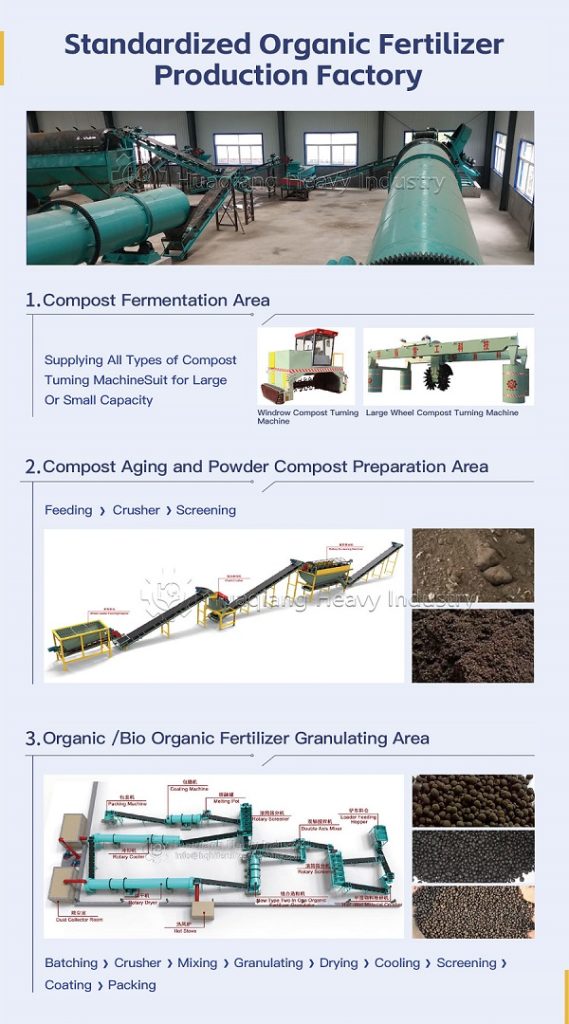
Composting is the fundamental step in organic fertilizer production. At this stage, the compost turner plays a crucial role. Taking a large-scale farm in Shandong as an example, the farm produces approximately 50 tons of chicken manure daily. By installing a fully automatic compost turning system, the fermentation cycle has been shortened from the traditional 45 days to 25 days. The turner runs automatically every 4 hours, ensuring thorough mixing and aeration of the materials, maintaining the fermentation temperature within the optimal range of 55-65℃, and effectively killing pathogens and weed seeds. After thorough decomposition, the organic matter content reaches over 45%, providing high-quality raw materials for subsequent processing.
The Improvement of Pre-treatment Processes
The pre-treatment stage directly affects the uniformity of the final product’s quality. Semi-wet material crushers play a crucial role in this stage. An organic fertilizer plant in Henan province uses a new type of crushing equipment to process mixtures of pig manure and straw. This equipment is equipped with a specially designed blade system that can crush the material to a fineness of over 80 mesh while maintaining a suitable moisture content. The crushed material then enters a twin-shaft mixer. In a demonstration project in Jiangsu province, the mixer, through its bidirectional stirring design, achieves a uniformity of over 95% for the various raw material components, laying a solid foundation for the granulation process.
Innovative Development of Granulation Technology Granulation is a core technological step in organic fertilizer production. Plants of different sizes can choose suitable equipment types based on their needs. In a small organic fertilizer plant in Zhejiang province, disc granulators are favored for their flexibility and ease of operation. By adjusting the disc inclination angle (35-50 degrees) and rotation speed (15-25 rpm), this equipment can produce uniform granules with a diameter of 2-4 mm and a pelleting rate of over 85%. Meanwhile, in a large fertilizer company in Hebei province, drum granulators are being used due to their high capacity advantage; a single unit can produce 5 tons of granulated fertilizer per hour, achieving large-scale continuous production.
Improved Post-Processing Technology: Drying and cooling processes ensure product stability. A fertilizer plant in Guangdong uses a rotary dryer with an intelligent temperature control system to reduce granule moisture content from 25% to below 12%. This equipment is equipped with a heat recovery device, using exhaust waste heat to preheat intake air, reducing energy consumption by 30%. The cooling system uses a counter-current design. In a project in Anhui, the cooler rapidly reduced granule temperature from 80℃ to room temperature, while simultaneously improving the mechanical strength of the granules, achieving a compressive strength of over 15 Newtons.
Intelligent Upgrades in Screening and Packaging: Screening and packaging processes reflect the modernization level of the production line. In a newly built fertilizer plant in Sichuan, the rotary screen uses a three-layer screen design, enabling precise separation of granules of different sizes. Qualified products enter an automatic packaging system that integrates weighing, bagging, and sealing functions, achieving a packaging accuracy of ±0.5%. Production data from the plant shows that the automatic packaging system increased packaging efficiency by 3 times while reducing the number of operators by 2.
Diverse Applications of the System: The organic fertilizer production system has good adaptability. Small-scale production lines require less investment and yield quick results, making them suitable for family farms and small-scale livestock farms. For example, a tea-growing cooperative in Yunnan uses a simple production line to process pruned tea leaves and livestock manure, producing 200 tons of organic fertilizer annually, meeting its own needs while generating additional revenue.
Large-scale production lines demonstrate the advantages of industrialized production. A modern fertilizer plant in Jilin uses a fully automated production line, with intelligent control from raw material processing to finished product packaging. This production line has an annual processing capacity of 50,000 tons, supplying not only the local market but also exporting to Southeast Asian countries.
Both environmental and economic benefits are achieved. The widespread application of these production systems has brought significant environmental benefits. It is estimated that processing 1 ton of organic waste is equivalent to reducing carbon dioxide emissions by approximately 1.5 tons. Simultaneously, the produced organic fertilizer improves soil structure, increasing crop yield and quality. In apple-growing areas of Shaanxi, orchards using organic fertilizer have seen a 2-degree increase in fruit sugar content and a 15% increase in yield compared to traditional fertilization methods.
The economic benefits are equally considerable. A livestock farm in Hunan province, using an organic fertilizer production system, has increased its annual revenue by over 3 million yuan by processing manure into fertilizer, with an investment payback period of only 18 months. More importantly, the system helped the company solve environmental compliance issues and avoid potential penalties for pollution.
Integrated System Design from Composting to Granulation
The described production flow illustrates a complete organic fertilizer manufacturing system, where each stage is interconnected. The process begins with intensive aerobic composting, efficiently managed by equipment such as a large wheel compost turning machine or a chain compost turning machine to accelerate decomposition and produce stable compost. This compost then becomes the primary feedstock for a dedicated organic fertilizer production line. The core stage of this line is organic fertilizer production granulation, where the material is shaped into a marketable form.
Several granulation technologies are employed in modern organic fertilizer manufacturing. A traditional and effective method is the organic fertilizer disc granulation production line, which forms spherical pellets through a tumbling action. For operations seeking process integration and space efficiency, a new type two in one organic fertilizer granulator that combines mixing and granulation is an innovative solution. More complex setups, such as an organic fertilizer combined granulation production line, may integrate multiple granulation methods to achieve specific product characteristics. The choice of technology is tailored to the scale, raw material properties, and final product requirements of the operation.
This systematic approach—from managed composting to flexible granulation—ensures that organic waste is transformed into a consistent, high-quality fertilizer product. The seamless integration of these stages is what defines a professional and efficient organic fertilizer production facility, capable of turning environmental challenges into agricultural opportunities.
Future Development Trends
With technological advancements, organic fertilizer production systems are developing towards greater intelligence and efficiency. The application of new biological additives can further shorten fermentation time, intelligent control systems enable more precise process management, and the utilization of green energy will reduce production energy consumption. These innovations will drive organic fertilizer production systems to play a greater role in sustainable agricultural development, making significant contributions to resource recycling and environmental protection.