High-efficiency NPK blending fertilizer production line: Behind precise proportioning

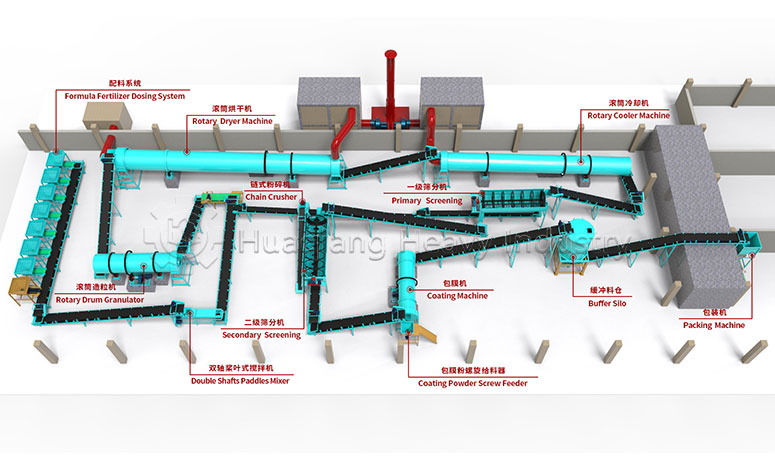
A modern NPK blending fertilizer production line is a combination of precision and efficiency. It no longer relies on heavy manual labor, but instead uses a series of specialized equipment to transform basic fertilizers such as nitrogen, phosphorus, and potassium into homogeneous products that meet specific needs.

The production line begins with the feeding and conveying of raw materials. At the batching station, precise metering devices lay the first cornerstone for subsequent uniform mixing, ensuring the accuracy of the final product’s nutrient ratio.

Then, the raw materials enter the core of the production line—the NPK blending machine. This equipment is the soul of the entire process; it strives to ensure that every fertilizer granule contains essentially the same amount of nutrients, and its mixing quality directly determines the final quality of the fertilizer.
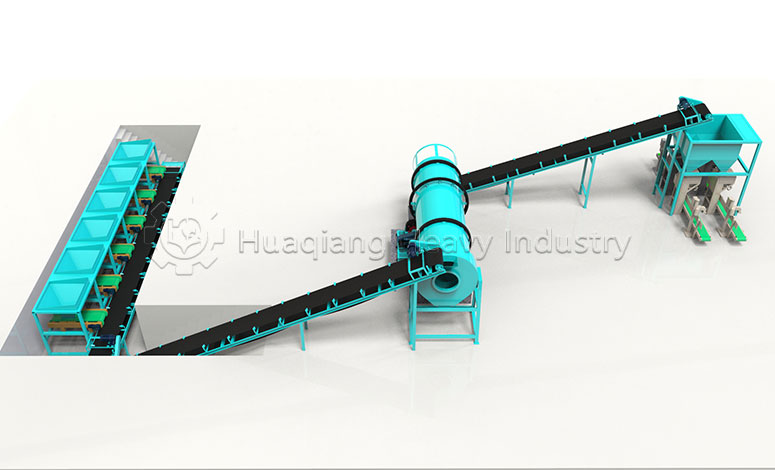
After the NPK blending machine has completed its mission, to further improve the consistency and stability of the product, the mixture sometimes undergoes a polishing or conditioning process. Following this, the finished product undergoes final metering and packaging through a high-efficiency bulk blending fertilizer machine.

Throughout the entire production line, the concept of a fertilizer mixer machine is often integrated into the broader category of mixing equipment. Whether used as a pre-mixing device for small amounts of trace elements or integrated into a more powerful NPK blending machine, the core concept of “stirring and mixing” remains constant.

In short, a well-configured NPK blending fertilizer production line achieves precise mixing through an NPK blending machine and efficient output through bulk blending fertilizer machines, demonstrating a direct response of modern fertilizer production to the demands of “precision agriculture.”

From powder to granules: How fertilizer granules compaction technology is reshaping agriculture?

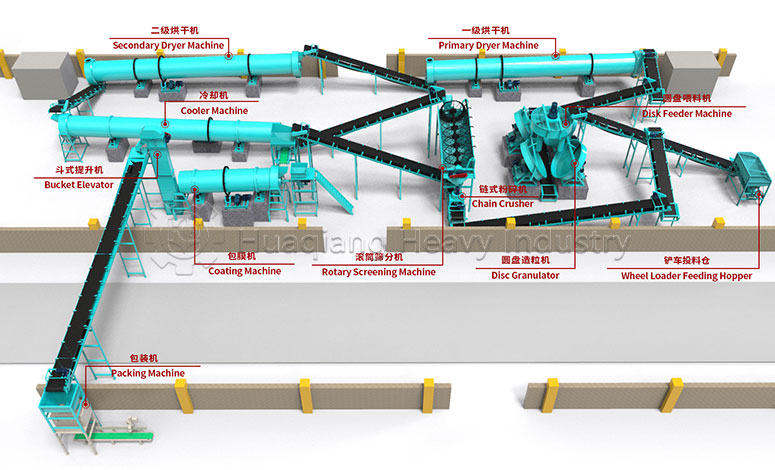
Step into the fields, and you’ll find that fertilizers today are vastly different. Uniform, round granules have replaced the dusty powder of the past—this is thanks to the revolutionary fertilizer granules compaction technology.

Fertilizer granules compaction technology uses mechanical pressure to directly press various raw materials into regular granules. This method eliminates the need for drying, ensuring complete nutrient retention. This physical forming method is particularly suitable for organic fertilizer production.

In modern fertilizer production, different product lines each have their own characteristics. New type organic fertilizer granulators can process diverse raw materials such as straw and livestock manure, producing granules that are not only easy to apply but also significantly reduce environmental pollution. In NPK fertilizer production lines, fertilizer granules compaction technology achieves precise proportions and uniform distribution of nutrients such as nitrogen, phosphorus, and potassium, ensuring each granule contains balanced nutrients. As for bio-organic fertilizer production lines, they successfully maintain the activity of functional bacteria during the granulation process, achieving a perfect combination of organic carriers and microorganisms.

The changes brought about by these technological advancements are evident. The transformation from powder to granules may seem like just a change in form, but it is actually a microcosm of precision agricultural management. With the continuous advancement of fertilizer granules compaction technology, fertilizers are nourishing our land in a more efficient and environmentally friendly way.

Rotary drum granulator: Core equipment for high-efficiency fertilizer production

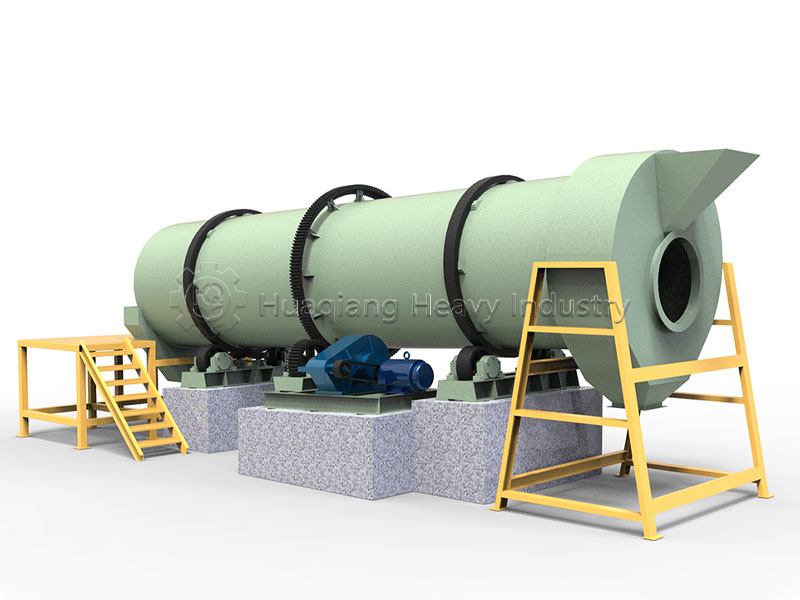
Stepping into a modern fertilizer production workshop, a large cylindrical device rotates smoothly—this is the rotary drum granulator. As a key piece of equipment in fertilizer production, it uses a unique rotary motion to aggregate powdery raw materials into uniform granules, becoming an indispensable part of fertilizer production.

In the NPK fertilizer production line, the rotary drum granulator plays a crucial role in connecting upstream and downstream processes. In the previous process, various raw materials are precisely proportioned and thoroughly mixed; here, the mixed material undergoes granulation to achieve an ideal physical form. This form not only facilitates subsequent packaging, storage, and transportation but also ensures the uniform release of nutrients during fertilizer application.

Unlike NPK blending machines, which simply perform physical mixing, the rotary drum granulator adds an appropriate amount of liquid phase component, forming granules that nucleate, grow, and compact during rotation. This process maintains the flexibility required for formulation in NPK blending fertilizer production lines while giving the fertilizer product better physical properties. The granulated fertilizer particles have higher strength and more uniform particle size, effectively reducing dust pollution during use.

In a complete NPK blending fertilizer production line, the process parameters of the rotary drum granulator need to be precisely adjusted according to the characteristics of the formula. The humidity and temperature of the raw materials, as well as the rotation speed and tilt angle of the equipment, all affect the quality of the final product. Modern rotary drum granulators have seen significant improvements in energy consumption control, automation, and product quality, providing a reliable guarantee for the production of high-quality compound fertilizers.

A new vision in granulation: The silent revolution of double roller press technology

On the stage of organic fertilizer production, the double roller press granulator is showcasing its unique value in a low-key yet highly efficient manner.

Walking through the fermentation zone, you’ll see a windrow compost turning machine working methodically. It continuously turns and aerates the mixture, preparing fully decomposed raw materials for subsequent processes. These materials are then transported to the next stage.

Here, the double roller press granulator begins its performance. Without high-temperature heating or the addition of binders, it directly compresses powdery materials into uniform granules through two precisely matched rollers. The entire process is clean and efficient, with a satisfactory granule formation rate and uniform particle size for easy packaging and application.

This granulation method represents the development direction of new type organic fertilizer granulators, pursuing lower energy consumption, a simplified process, and more stable quality. Under the extrusion of the rollers, strong molecular bonding forces are generated between the raw material particles, forming robust granules that ensure the product is not easily broken during transportation and storage.

Modern bio-organic fertilizer equipment emphasizes the continuity and automation of the production process, and the double roller press granulator perfectly embodies this concept. Its simple structural design, convenient operation, and seamless integration with upstream and downstream processes provide a reliable guarantee for the production of high-quality bio-organic fertilizer.

From the fermentation preparation by the windrow compost turning machine to the precise molding by the double roller press, and then to the subsequent finishing processes, these devices together constitute the complete picture of modern organic fertilizer production.

Rotary drum granulator: The art and efficiency of fertilizer granulation

In modern fertilizer production, the rotary drum granulator plays an indispensable role. Unassuming yet highly efficient, it transforms powdery raw materials into uniform granules, greatly facilitating fertilizer application and transportation.

In a complete organic fertilizer production line, the rotary drum granulator is often a core component. It is frequently connected to a fertilizer mixer machine. This equipment is responsible for thoroughly and uniformly mixing various raw materials, whether basic elements like nitrogen, phosphorus, and potassium, or materials rich in organic matter.

Once the uniformly mixed material enters the rotary drum granulator, the real transformation begins. As the drum slowly rotates, the fine powder particles, under suitable humidity and motion, adhere, encapsulate, and gradually grow like snowballs, ultimately forming uniformly sized granules.

The synergistic effect of this equipment is even more pronounced in the production of bio-organic fertilizers. Bio-organic fertilizer equipment is typically a system, not solely reliant on a single machine. From the fermentation and crushing of materials, to the mixing by the fertilizer mixer, and finally to the forming by the rotary drum granulator, each step is closely linked. The value of the rotary drum granulator in this process lies in its ability to effectively process organic materials, forming granules of moderate strength that are conducive to slow release into the soil.

A quietly changing force in agriculture: The new type organic fertilizer granulator

In the fields, a quiet revolution is underway. It’s unassuming, yet undeniably enhancing soil vitality. At the heart of this transformation is a seemingly ordinary yet crucial piece of equipment—the new type organic fertilizer granulator.

The core of this equipment lies in its efficient shaping of fermented organic materials. Without complex principles, its unique mechanical design produces uniform, firm granules. These granules possess good compressive strength, are not easily broken, and are easy to transport and store.

Granulation is not an isolated step. In a complete bio-organic fertilizer production line, it occupies a critical downstream position. Before this, the raw materials typically undergo a fermentation stage. This is where the windrow compost turning machine demonstrates its value—it slowly moves across the compost pile, regularly turning it to evenly supply oxygen to the material, promoting a stable and efficient fermentation process.

The changes brought about by granular fertilizer are tangible. It effectively reduces dust during application, improving fertilization precision. The granules slowly release nutrients into the soil, increasing fertilizer utilization. For growers, lightweight and standardized packaging also makes handling and storage easier.

The significance of this new type organic fertilizer granulator lies perhaps in its ability to make the use of organic fertilizer simpler and more efficient. Working in conjunction with equipment such as windrow compost turning machines, it forms a modern bio-organic fertilizer production line, allowing organic waste to return to the land in a more dignified way, completing the cycle of matter.

How organic fertilizer production lines transform waste into fertile soil “Gold”?

Under the concept of circular agriculture, organic fertilizer production lines are quietly undergoing a transformation. They are no longer simple processing facilities, but rather a bridge for resource transformation, turning ubiquitous agricultural waste into valuable resources that nourish the land.

The entire production line begins with scientific proportioning and mixing. Here, the fertilizer mixer machine plays a central role. Through its unique structural design, it can uniformly mix raw materials of varying properties—whether it’s viscous livestock manure or dry straw powder—in a short time. This efficient mixing not only improves production efficiency but also ensures the stability of subsequent fermentation quality.

When the production line needs to meet more specific nutrient requirements, it demonstrates its strong compatibility. By introducing the proportioning concept of NPK fertilizer production lines, the system can precisely add elements such as nitrogen, phosphorus, and potassium, forming a perfect complement to organic matter. This scientific combination of organic and inorganic elements retains the advantages of traditional organic fertilizers in improving soil while compensating for their lack of rapid effectiveness.

From the turning and ventilation during fermentation, to the precise temperature control during aging, and the shaping process in granulation, each stage reflects a deep understanding of the material’s properties. The final product is not just uniform fertilizer pellets, but a commitment to the health of the land.

This modern production line is redefining the value of “waste.” It allows agriculture to return to its cyclical nature, enabling nutrients to find a new home within the ecosystem.

How does an intelligent bio-organic fertilizer production line efficiently granulate and produce fertilizer?

In a modern factory, a bio-organic fertilizer production line is quietly operating. Here, there’s no pungent odor like in traditional fertilizer plants, only the rhythmic sounds of equipment, witnessing the entire process of transforming organic waste into treasure.

After being scientifically proportioned, the raw materials enter the core granulation section. The new type organic fertilizer granulator demonstrates its unique value: without chemical binders, it uses precisely designed physical pressure to shape loose fermented materials into uniform and firm granules. These black granules are convenient for storage and transportation, and also allow for the slow release of nutrients into the soil.

The coordinated operation of the entire bio-organic fertilizer equipment is impressive. From raw material crushing and fermentation to granulation and drying, each step is meticulously designed. In particular, the new type organic fertilizer granulator can flexibly adjust the particle size and hardness to meet the needs of different crops and soils.

In the finished product workshop, the granulated fertilizer, after strict quality inspection, is automatically weighed and packaged. These black granules, transformed from waste, are about to begin a new mission—returning to the earth, improving soil structure, and providing lasting nutrients for crop growth.

This production line is not only a demonstration of technology, but also a vivid example of circular agriculture. It gives new life to agricultural waste, transforming pollutants into nutrients. Behind these seemingly ordinary black granules lies the wisdom of sustainable development in modern agriculture.

Fertilizer mixer machines: Connecting fertilizer production line and quality

In the vast landscape of fertilizer production, the fertilizer mixer machine plays a silent yet crucial role. It doesn’t possess the power of a crusher, nor the shaping ability of a granulator, but it is the core element determining the homogeneity of the product.

Walk into any modern NPK fertilizer production line, and you’ll almost always find it in a core section. Various precisely measured nitrogen, phosphorus, and potassium raw materials, along with trace amounts of additives, are fed into it. Whether it’s the powerful agitation of the twin-screw agitation or the uniform tumbling of the horizontal drum, the goal is crystal clear: to fuse materials of varying shapes and densities into a uniform, nutrient-rich mixture in the shortest possible time.

When the scene shifts to a bio-organic fertilizer equipment array, the fertilizer mixer machine takes on a more nuanced role of “harmonizing.” The materials processed here are more complex—fermented organic matter, livestock manure, peat moss, or microbial residue, all with varying moisture content and loose textures. The mixer needs to provide gentler and more sustained agitation here to ensure that the organic raw materials come into full and even contact with the appropriate amount of functional microbial agents, nitrogen-fixing and phosphorus-solubilizing bacteria, and other microbial communities, avoiding localized over-concentration or under-concentration of the microbial community.

Therefore, whether it’s an NPK fertilizer production line pursuing precise chemical ratios or a bio-organic fertilizer equipment emphasizing biological activity, the mixer is an indispensable “link.”

High-efficiency compost turning drives a green future: A visit to windrow compost turning machines

On the vast fields of bio-organic fertilizer production sites, one can always see some “silent cultivators” working methodically. These are windrow compost turning machines.

Unlike traditional stationary equipment, the tracked design gives it unique flexibility. The wide tracked chassis allows it to easily handle soft material piles without sinking, moving freely. It slowly travels between windrow compost stacks, evenly tossing and scattering the material as it passes, completing a thorough gas exchange.

In the entire bio-organic fertilizer production line, compost turning is one of the core processes. This bio-organic fertilizer equipment plays a crucial role: it thoroughly breaks up the piled material, regulating its moisture and temperature, allowing microorganisms to actively multiply in a more suitable environment. As an important piece of bio-organic fertilizer equipment, its value lies in its stability and efficiency. Without complicated operations, it can process large quantities of raw materials day and night, significantly improving the overall efficiency of the bio-organic fertilizer production line.

As a windrow compost turning machine moves among the raw materials, the entire bio-organic fertilizer production line is injected with powerful energy. With its robust and reliable presence, it silently drives the transformation from raw materials to finished products, becoming an indispensable and solid force in the modern organic fertilizer manufacturing field.