There is no fixed standard for how long compound fertilizers processed by NPK fertilizer production lines remain in the soil. The duration depends primarily on the characteristics of the three nutrients—nitrogen, phosphorus, and potassium—and is also influenced by soil type, climate, and application method. Accurately understanding these factors can improve fertilizer efficiency and reduce waste.
Nitrogen has the shortest retention period and is easily lost, existing as ammonium nitrogen and nitrate nitrogen: ammonium nitrogen is easily adsorbed by the soil, with a retention period of about 15-30 days; nitrate nitrogen is highly mobile and only remains for 7-15 days. High temperatures, heavy rainfall, and excessive watering will accelerate its loss, which is why nitrogen fertilizer needs to be applied in multiple applications.
Phosphorus has the longest retention period and is easily fixed. After application, it easily combines with elements such as calcium and iron in the soil, forming insoluble compounds, with a retention period of several months to several years. Once fixed, it cannot move, so it needs to be applied near the crop roots. Combining it with organic fertilizer can reduce fixation and improve utilization.
Potassium has an intermediate retention period and is easily leached. It is adsorbed by soil colloids in ionic form, with a retention period of about 30-60 days. Sandy soils have weak adsorption capacity, resulting in a shorter retention period; clayey soils have strong adsorption capacity, resulting in a longer retention period. Long-term single application can reduce the soil’s adsorption capacity.
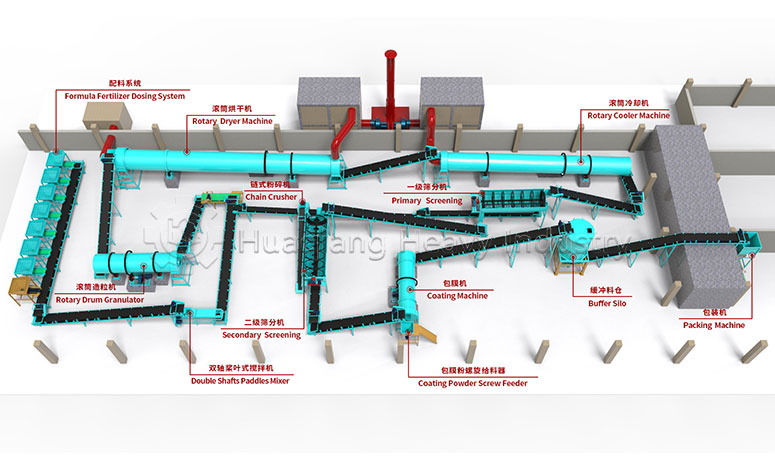
The fertilizer formulation also affects the retention time. Granular fertilizers processed by fertilizer granulator machines using NPK compound fertilizer granulation technology have a slower nutrient release rate and a longer retention period than powdered fertilizers. Combining them with organic fertilizers and controlling the application depth can further extend the retention period.