Roller press granulator production line: High-efficiency dry granulation, aiding fertilizer production upgrades

Roller press granulator production lines represent a highly representative dry process. They require no water addition or drying, relying on complete fertilizer production equipment to complete granulation, making them particularly suitable for producing moisture-sensitive raw materials.

The core principle is mechanical extrusion granulation, a simple and efficient process: After precise batching, raw materials are fed into a double axis paddle mixer for thorough mixing, then fed into a double roller press granulator via a quantitative feeding device. Under high pressure, the dry powder raw material is pressed into sheets, which are then crushed, screened, and shaped to obtain uniformly sized finished granules. Substandard materials can be recycled for reprocessing, improving raw material utilization.
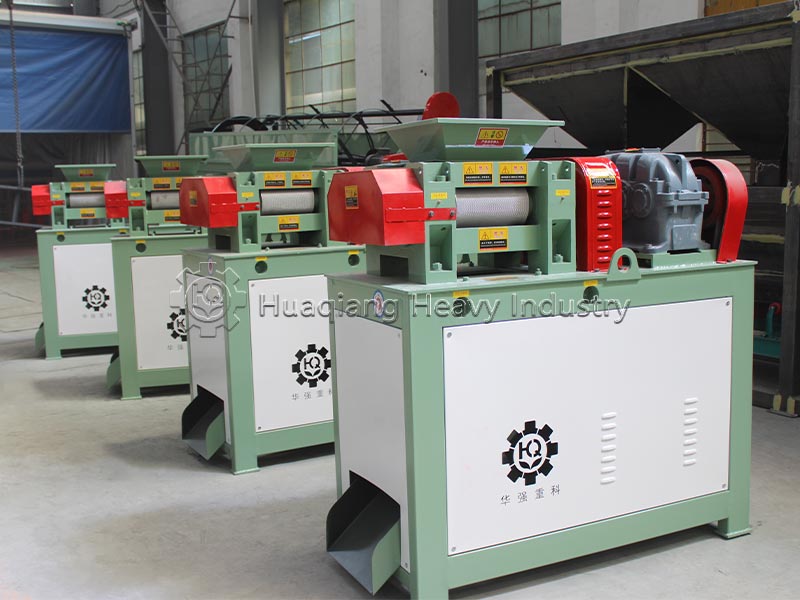
Compared to wet granulation, its advantages are significant: no wastewater or waste gas is generated throughout the process, resulting in superior environmental friendliness; the elimination of the drying stage significantly reduces energy consumption and production costs, shortening the production cycle. The produced granules have high hardness, are not prone to clumping, are stable during storage and transportation, are suitable for mechanized fertilization, and meet the needs of large-scale planting.

This production line is highly adaptable and can produce various ratios of NPK compound fertilizers, single-element fertilizers, and blended fertilizers. The formula can be flexibly adjusted to quickly respond to market demands. During production, only the roller pressure, feeding speed, and screening accuracy need to be controlled to consistently ensure the quality of the finished product.

As an energy-efficient and highly effective dry granulation solution, the roller press granulator production line effectively solves the pain points of traditional processes, helping fertilizer companies reduce costs and increase efficiency.
Detailed process flow of roller press granulator production line

Roller press granulator production lines, with their advantages of cold pressing, energy efficiency, and wide compatibility with raw materials, are widely used in the processing of compound fertilizers and organic fertilizers. They eliminate the need for high-temperature drying, maximizing the retention of raw material activity and nutrients.

Raw Material Pretreatment: First, the raw materials are precisely proportioned according to a preset ratio. Inorganic raw materials such as urea and monoammonium phosphate, or well-rotted organic materials, are mixed with auxiliary materials and fed into a fertilizer mixer for homogenization, ensuring uniform nutrient distribution. Then, the material is processed by crushing and screening equipment to achieve a particle size of 80 mesh or higher, while simultaneously adjusting the moisture content to 8%-12% to avoid clumping or poor forming.

Roller Pressing: The pretreated material is fed into a double roller press granulator. High pressure is applied by a pair of counter-rotating rollers, pressing the loose material into dense flakes or blocks. The roller pressure needs to be finely adjusted according to the material characteristics. Insufficient pressure will result in brittle particles, while excessive pressure may damage the equipment and affect solubility; precise control is essential.

Post-Processing Screening: The raw material is crushed into irregular particles by a crusher, then classified by a fertilizer screener machine. Qualified particles enter subsequent stages, while unqualified coarse particles and fine powder are returned to the pretreatment stage for reprocessing, forming a closed-loop production process and improving raw material utilization. Finally, qualified particles are quantitatively packaged and sealed for storage.

This process is simple and compact, with low energy consumption and strong environmental friendliness. It is suitable for processing various material combinations and is an ideal choice for small- to medium-capacity fertilizer production lines.