Driven by the dual goals of carbon peaking, carbon neutrality, and green development policies, the fertilizer industry is facing a profound green transformation. “Zero emissions” and “low energy consumption” are no longer merely policy constraints, but intrinsic requirements for enterprises to enhance competitiveness and achieve sustainable development. Building a systematic environmental compliance system requires coordinated efforts in two aspects: comprehensive treatment of waste gas, wastewater, and waste residue, and energy-saving optimization of production processes.
Waste Gas Treatment: From “Harmlessness” to “Resource Utilization” During fertilizer production, processes such as raw material fermentation and drying easily generate irritating and harmful gases such as ammonia and hydrogen sulfide. Traditional open-loop treatment methods can no longer meet increasingly stringent emission standards, necessitating a systematic solution of “closed collection + tiered purification.”
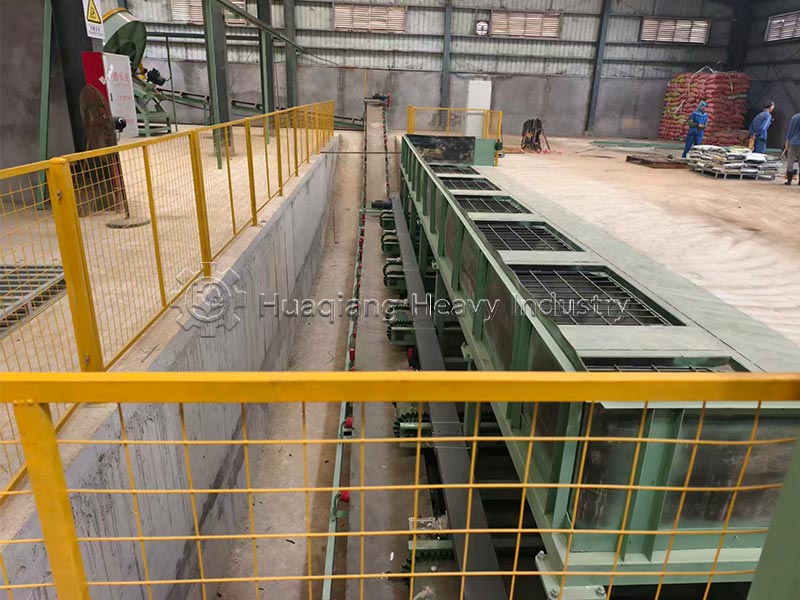
Taking the organic fertilizer production line designed by Zhengzhou Huaqiang Heavy Industry as an example, by establishing a fully enclosed fermentation workshop, waste gas is collected centrally and first recovered through a condensation tower to achieve resource reuse; the remaining gas then enters a biofilter, where microbial metabolism degrades odorous substances such as hydrogen sulfide. This process not only reduces exhaust gas emission concentrations far below the “Odor Pollutant Emission Standard” (GB 14554-93), but also lowers nitrogen loss through ammonia recovery, achieving both environmental and economic benefits. Simultaneously, air curtains and negative pressure systems at workshop entrances and exits, combined with atomizing deodorization devices, significantly improve the factory area and surrounding environment.
Wastewater and Solid Waste: Recycling for “Zero Waste”
Wastewater from fertilizer production mainly originates from raw material washing, equipment cooling, and workshop rinsing. To achieve “zero emissions,” a graded treatment and recycling water resource management system needs to be established: suspended solids are removed through sedimentation and flotation, followed by biochemical treatment to degrade organic matter. The treated water can be used for raw material humidification, granulation humidification, or equipment cooling, forming an internal water cycle within the factory and significantly reducing the amount of fresh water required.
Solid waste can also be converted into resources. Screen residues and insufficiently strong particles generated during production can be crushed and reused in the granulation process; some fine powder can also be sold as a horticultural substrate or soil conditioner. This not only reduces the pressure of solid waste disposal but also improves the comprehensive utilization rate of raw materials and lowers production costs.
Low Energy Consumption Optimization: A Dual Approach of Technology and Management
Reducing energy consumption requires starting from the source—equipment selection and process design. In the granulation stage, using a rotary drum granulator equipped with a variable frequency control system allows for automatic speed adjustment based on material conditions, avoiding energy waste caused by over-engineering and saving over 30% more electricity than traditional fixed-speed equipment. For heat-sensitive materials, “room-temperature forming” processes such as roller pressing can be used, eliminating the drying stage and directly reducing heat consumption.
Furthermore, establishing an intelligent energy monitoring platform collects real-time data on electricity, water, and gas consumption at each stage. Analysis identifies energy efficiency bottlenecks, providing a basis for continuous improvement. Regular equipment maintenance and thermal system optimization are conducted, such as recovering waste heat for raw material preheating, further tapping into energy-saving potential.
Building a Long-Term Environmental Management System
Environmental compliance is not a one-time investment but a dynamic process requiring long-term commitment. Enterprises should establish internal environmental management systems, clarify responsibilities at each stage, and conduct regular emission testing and audits. Simultaneously, maintaining technical collaboration with equipment suppliers and leveraging their experience allows for rapid process optimization. For example, partnering with suppliers like Huaqiang Heavy Industry, which possess comprehensive solution capabilities, provides access to full-cycle services from engineering design and equipment integration to operational support, significantly reducing the technical risks and time costs of addressing environmental requirements independently.
Closed-Loop and Efficient Organic Fertilizer Production
Achieving the “zero emissions” and “low energy consumption” goals requires an integrated approach within the organic fertilizer manufacturing system. This begins with controlled aerobic fermentation, managed efficiently by equipment like a large wheel compost turning machine or a chain compost turning machine, within enclosed facilities to manage emissions. The cured compost then enters a dedicated organic fertilizer production line. The core stage of organic fertilizer production granulation offers several technology paths, each with different energy profiles.
For energy-efficient shaping, a traditional organic fertilizer disc granulation production line using an organic fertilizer disc granulation machine is common. To save space and process steps, a new type two in one organic fertilizer granulator that combines mixing and granulation can be effective. More complex organic fertilizer combined granulation production line setups may integrate multiple methods. The selection of granulation technology directly impacts the need for subsequent drying, a major energy consumer, and thus must be aligned with the overall environmental strategy of the organic fertilizer manufacturing operation.
Therefore, a truly sustainable organic fertilizer plant integrates emission control from the composting stage with energy-conscious equipment selection in the granulation and drying stages, creating a holistic production system that is both environmentally compliant and economically viable.
Conclusion: Environmental Compliance is the Cornerstone of High-Quality Development. Facing the era’s challenge of green manufacturing, fertilizer producers should deeply integrate environmental requirements into their entire production and operation process. Achieving “zero emissions” through systematic waste gas, wastewater, and waste residue treatment, and reducing energy consumption through energy-saving technologies and refined management, not only meets regulatory requirements and mitigates operational risks but also improves resource efficiency, cultivates a green brand image, and ultimately gains a long-term development advantage in the industry’s transformation. Environmental compliance has become an essential path for fertilizer companies to move from “compliant survival” to “green competitiveness.”