In August 2024, four flat die pelleting production lines, custom-designed for a Qingdao client by Zhengzhou Huaqiang Heavy Industry Technology Co., Ltd., completed full-process installation and commissioning, successfully entering the large-scale production stage. This production line focuses on the high-efficiency granulation needs of organic fertilizers and compound fertilizers, integrating core processes such as crushing, mixing, granulation, drying, coating, and screening. With multi-equipment collaboration, highly automated configuration, and stable operating performance, it has become a benchmark project for high-end flat die pelleting machine equipment applications in China, providing local fertilizer production enterprises with a one-stop mass production solution.
Production Line Full-Process Configuration and Process Analysis
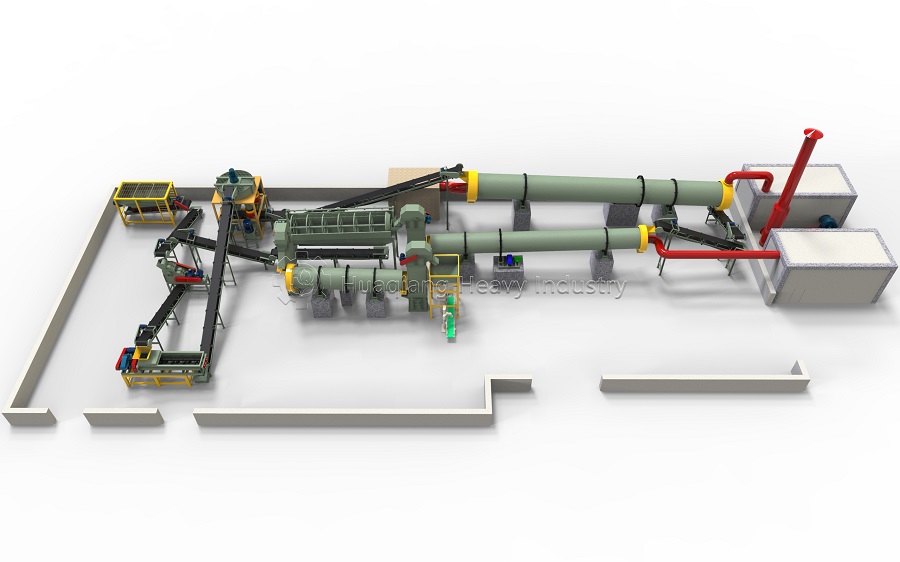
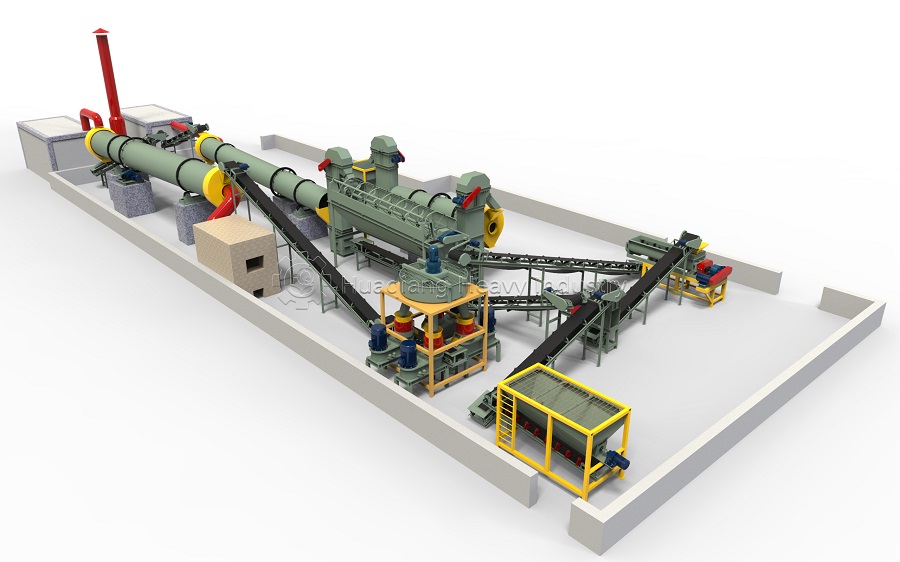
The entire production line follows a closed-loop design of “raw material pretreatment – precision granulation – post-processing and finishing – finished product output.” The equipment layout is scientific, the connections are smooth, and the functions of each unit are complementary, fully ensuring production efficiency and product quality.
Raw Material Pretreatment Unit: Laying the Foundation for Uniform Granulation
Raw Material Feeding and Crushing: The production line starts with a loader-loaded hopper, adapting to the rapid feeding requirements of bulk raw materials. The feed inlet features a spill-proof design to reduce raw material loss. Raw materials are conveyed via a 7-meter belt conveyor to a 60×50 type double-stage crusher. This equipment adopts a “coarse crushing + fine crushing” double-stage crushing structure. The cutter disc is made of high-strength alloy material, which can crush large raw materials (particle size ≤100mm) into uniform particles ≤3mm, with a crushing efficiency of 5 tons/hour, meeting the stringent requirements for raw material fineness in subsequent granulation.
Precision Mixing Process: The crushed raw materials are transferred via a 7-meter belt conveyor to a 50 type twin-shaft mixer. The equipment adopts an anti-rotating blade design with a wear-resistant coating on the blade surface. During the mixing process, the material forms strong convection and shearing action, ensuring uniform mixing of main raw materials such as nitrogen, phosphorus, and potassium with trace elements, with a mixing uniformity error ≤2%. The mixer is equipped with a variable frequency speed control system, which can adjust the mixing speed (15-30 r/min) according to the characteristics of the raw materials. It also supports automatic feeding and unloading control to ensure continuous production.
Core Granulation Unit: 4 Main Units Operating in Parallel for Enhanced Efficiency
The mixed material is conveyed via a 12-meter belt conveyor to a 2200-type disc feeder. This feeder uses variable frequency speed control and automatic material level control technology to precisely regulate the feed rate, ensuring uniform feeding of the four 50-type flat die pelleting machines and avoiding fluctuations in granulation quality due to uneven feeding.
The parallel operation of the four flat die pelleting machines is the core highlight of the entire production line. Each unit has an hourly output of 1.5 tons, and the combined operation achieves the designed total capacity of 6 tons/hour. The granulator adopts a high-strength flat die design, with die hole diameters customizable according to customer needs (3-8mm). The pressure rollers are made of wear-resistant rubber and metal composite material, and the pressure is precisely controlled (8-12MPa) through a hydraulic pressurization system, ensuring a stable material forming rate of over 90% and a particle strength of 2.5MPa, making it less prone to pulverization. The equipment operates at a noise level below 75dB and is equipped with an automatic die cleaning device, effectively reducing die hole clogging and extending continuous operating time.
Post-processing and finishing unit: Improving product quality and stability
Drying and cooling stage: The wet granules after granulation are transferred to a 1.5x15m dryer via 4m and 12m belt conveyors. The equipment adopts a hot air circulation heating design, with a No. 26 hot air furnace providing a stable heat source. The drying temperature can be precisely controlled within the range of 60-120℃, reducing the particle moisture content from 30% to below 12%, with a drying efficiency of 8 tons/hour. After drying, the granules are conveyed via 5-meter and 6-meter belt conveyors to a 1.2×12-meter cooler. A counter-current cooling process is used, with the cooling time controlled within 15 minutes, rapidly reducing the granule temperature to room temperature (±5℃), effectively improving granule hardness and storage stability.
Coating and Sieving Optimization: The cooled granules are then conveyed via a 5.5-meter bucket elevator to a 130-type spiral duster. After pre-treatment to prevent moisture absorption and agglomeration, they enter a 1.2×6.0-meter coating machine. The coating machine uses a roller design and atomized spraying technology to evenly adhere the coating agent to the granule surface, forming a dense protective film, improving the slow-release effect of fertilizer nutrients and extending shelf life. The coated granules are transferred by bucket elevator to a 1.5×6.0 meter drum screen for grading and screening. Qualified granules (3-8mm in diameter) enter the finished product silo, while unqualified granules are returned to the crusher for reprocessing via 7-meter and 6-meter return conveyors, achieving a material utilization rate of 98%.
Environmental Protection and Finished Product Output Unit: Green Production + High-Efficiency Shipping
Environmental Protection System Configuration: The production line is equipped with dust collection chambers for the dryer and cooler, combined with 6C and 5C induced draft fans to form a negative pressure dust collection system. This system centrally collects and treats dust generated during production, achieving a dust emission concentration ≤10mg/m³, meeting national environmental standards. The chimney and water tank are linked for water washing and purification of the hot air furnace exhaust gas, reducing pollutant emissions and achieving green production.
Finished Product Packaging and Storage: After qualified finished products are stored in the finished product warehouse, they are quantitatively packaged by an automatic packaging scale. The equipment supports switching between multiple specifications such as 25kg and 50kg, with a measurement error of ≤±0.2kg and a packaging speed of up to 100 bags/hour, meeting the needs of large-scale shipments. The packaged finished products are directly transferred to the stacking area via conveyor belt, with fully automated operation reducing manual intervention.
Core Advantages and Adaptability of the Production Line
High-Efficiency Mass Production Capacity: Four flat die pelleting machines operate in parallel + a fully automated design, significantly improving production efficiency. The capacity is three times higher than a traditional single-unit granulation production line, meeting the customer’s daily production demand of 120 tons.
Stable, Reliable, and Durable: Key equipment (crusher, granulator, dryer) and their core components adopt standardized and wear-resistant designs. Wear parts are highly interchangeable, and the overall equipment operating rate reaches over 95%, reducing subsequent maintenance costs.
Highly adaptable: Supports granulation of various materials such as organic fertilizer, compound fertilizer, and bio-organic fertilizer. Die diameter, coating formula, and packaging specifications can all be flexibly adjusted to meet the personalized production needs of different customers.
The successful commissioning of four flat die pelleting machine production lines in Qingdao fully demonstrates Huaqiang Heavy Industry’s professional strength in granulation equipment R&D and production line integration design. In the future, the company will continue to focus on market demand, optimize equipment performance and process solutions, and provide more domestic and international customers with efficient, stable, and environmentally friendly customized granulation production line solutions, contributing to the high-quality development of the agricultural industry.
Integrating Granulation Options into a Complete Production Ecosystem
This Qingdao project highlights the effective application of a high-capacity flat die pelleting machine system, demonstrating its role as a key fertilizer processing machine for specific material types and production scales. It represents one successful pathway within the diverse field of fertilizer granulation technology.
The flat die pelleting production line serves a specific niche, particularly well-suited for organic materials. For producers requiring a different approach, alternative technologies are available within the broader npk manufacturing process. For instance, a roller press granulator production line utilizes a fertilizer compaction machine (or fertilizer compactor) to perform fertilizer granules compaction via dry pressure. Conversely, a rotary drum granulator employs a wet agglomeration process. These choices complement other essential equipment, such as a windrow composting machine for producing the raw organic feedstock. Each piece of equipment represents a specialized solution, allowing manufacturers to select the optimal combination of fertilizer granulation technology based on their raw material properties, desired product form, and economic considerations.Ultimately, the success of a fertilizer production operation lies in matching the right granulation technology—whether flat die, roller press, or rotary drum—to the specific characteristics of the input materials and the requirements of the target market.
We warmly welcome people from all walks of life to visit, guide, and discuss business with us, and work together to create a new future for green agricultural development!